
 You may have already read the announcement in The Horse magazine -- the French company Cryozootech has produced a clone of Gem Twist, the famous jumper. Is this little guy (pictured left) a doll? The state of cloning has apparently advanced rapidly. Poetin has been cloned, and now Gem Twist (a gelding) may be able to be used in breeding. The cost of cloning is still rather high -- $150K, but its sure to come down. Horses are a good choice for the cloning industry, as their breeding value can go into the millions. The interest in cloning horses does beg a question, though. Will cloning someday be available to the consumer for their companion animals? Will people start to clone their horses? And more to the point, would I ever clone my horse?
 O brother where art thou?
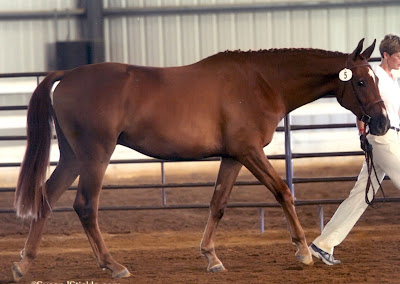
I have thought of "finding another Harvey" but not through cloning. I searched horse sale sites for Harvey's brothers/sisters. Several years ago, a horse appeared on Equine.com by Harv's sire, High Tribute. His name was Big Country (BC) and he is pictured right. BC looked amazingly similar to Harvey, and the owners kindly sent me a video. Harv and BC could be twins in terms of type and they had the same had/face. However Big Country was "hot" and his gaits were more impressive. His professional rider had trouble containing him in a first level test. His ears were pinned repeatedly and he kicked out a few times, but he definitely had a show ring presence. BC was reportedly schooling fourth level with FEI potential. Harvey, on the other hand, has a particularly kind way of going, and he's gotten 8's for obedience. His performance may not scream FEI, but when he's under saddle those ears are pricked forward!
Thinking of cloning?
If you have a few hundred thousand to spare, and have a horse or pony you're fond of, here are a few things to think about before you plunk your money down..

- Cloned horses are not copies of the original. Texas A&M produced five clones of a quarter horse stallion, and the clones look more like brothers than clones: they have different markings; they are different heights; their conformation differs. To explain the color differences, The Horse magazine article says, genetics call for white at the extremities, not necessarily specifying a location. Cells for white pigmentation can migrate differently in different individuals. So socks mix and match, and a donor might have one white hind sock while a clone gets a blaze. See the photos to the right of the barrel horse Scamper and his clone to the right.
- Although cloned horses don't experience the same level of health issues as sheep and cattle, they horses can experience problems early in life. This is because DNA pulled from cells will have some genes turned "on" while others are "off" depending on what type of cell the DNA is pulled from--skin cells will have skin-related genes turned "on". When the DNA is inserted into the oocyte, the DNA has to be reprogrammed to turn on the genes. Sometimes this process is not 100% reliable. Different animals have different kinds of health issues. Cloned baby horses are more prone to contracted tendons, oxygenation problems, low birth weight
- The uterus is a critical environmental factor that determines individual differences among horses -- even those that are genetically identical. Natural identical twin horses can vary dramatically in height--by as much as two hands. For example, differences in the availability of the placenta nutrients will alter a horse's appearance. And placenta seems to be the most affected part of cloning. The placenta of a cloned horse may not deliver nutritients as well as that of a non-cloned individual.
I can't really stomach the notion of consumers cloning their companion animal. Imagine cloning the horse of your life to find that the clone just "isn't your baby." And how unfair to the animal! Besides, isn't it kind of creepy anyway? Like hiring a taxidermist so you can still have your horse around?
RESOURCES ON HORSE CLONING
Equine cloning: Where are we today?
Champion clones join Texas horse stables from NPR
Equine Cloning Expert Reviews Successes, Challenges
Cloning the Equine from Google books
Nuclear transfer saddles up from Nature
Champion horse cloning
Worlds first horse cloning opportunity opens to the public from Medical News Today






 Why hoof conformation matters


.jpg)


