
Thanks to a BTB reader Christine for sending me the link to this video. I sometimes look for good horse videos but never would have found this. It's a French and Saunders sketch.
My favorite line is the "record" for catching their horses!
Saturday, February 28, 2009
Ponies: a British comedy sketch


Friday, February 27, 2009
"Before" and "After" / makeover shows: Love'em!
What not to wear (UK and US versions), Trading spaces, This old house--I love makeover shows, especially seeing the before and after. I don't know the Aussie trainer that published these videos, but they're horsie before/after sequences, and they're a hoot. The first one has the most naughty horse action, and although we don't see it apparently the horse damaged the judge's car. The rider, Mrs. HP, is the trainer's wife. The second one is early footage of Mrs. HP with husband commentary. Keep an eye on the horse's forelegs. If anyone asks you what is meant by "correct movement" you can offer this anti-example. Is the specific flaw called paddling?
Horse Before and After
Wife Before and After with husband commentary
Thursday, February 26, 2009
Equiheels: I'm not impressed
 At the barn where I keep Harvey, there is a delightful woman (Sara) who takes weekly lessons -- she always a big smile and great enthusiasm. Sara often borrows horses to ride in clinics, and she rode in a Lendon Gray clinic for adults last year. She told me that most participants were riders that were decidedly undiva-like on capable but modest-looking horses. There was one lady, though, on a big-moving warmblood and wearing fancy gear. She was having trouble controlling her horse. Round and round the ring she went at a huge trot that was close to a lengthening. Lendon's words to the rider were to HALF HALT, SLOW DOWN, but the lady seemed oblivious. Lendon is not one to mince words, and she boomed out "I am NOT IMPRESSED. Not impressed AT ALL!"
I second that! Equiheels product review The Lendon story, and particularly her sentiment, is a lead in for my product review. You know, I'm kind of a sucker for new-fangled products, from the AstrideTM surcingle to the Shoulders BackTM posture improver. If they're silly and frivolous, at least my gadgets have good intentions, -- helping me, or my horse, improve. When it comes to training "shortcuts," I draw the line. No draw reins. No crank nosebands. No flash attachment binding my horse's mouth shut.
My thoughts (Disclaimer: haven't tried it, won't try it)
When I saw the EquiheelsTM product ad appearing at the top of my Gmail mailbox, I thought it might be a new heel stretcher for riders. Gadget alert! Ever hopeful, I clicked. Nope, it's not a gadget to help you fix your riding problems. It's a heeel insert that supposedly creates the appearance that your heel is down while allowing you -- in fact encouraging you to ride en pointe like a ballerina. In other words, it's a gimmick to make you look like a better rider than you are. To quote Lendon Gray I am NOT IMPRESSED. Not impressed AT ALL!
To the maker of the product, I have these comments...
- I've worn, and seen other people wear, ill fitting boots that drop down at the heel -- the boot heel is several inches below the actual heel. It's obvious that the human heel is not at the bottom of the boot -- no one's ankle breaks at that telltale funny angle. Judges and trainers are not fooled and like me, NOT IMPRESSED.
- Did it occur to you that when the heel is down, the rest of the leg becomes more secure? The thigh drops down, the seat is closer to the saddle, and the rider finds a sweet spot of stability/balance. Your product actually prevents the rider from assuming a more correct position.
- What are we teaching kids by using this product? Isn't it a little deceptive? Kind of like cheating? I noted the ad copy on your Web site:
Yes, EquiHeels are legal and can be used in the show ring. Because they fit perfectly inside your boot, the best part is that no one will even know you're using them!
- How goofy are these kids going to look wearing flat heeled boots but walking like they're teetering down a runway in stilletos? More ad copy on your Web site:
Although you may be surprised at how comfortable they are to walk in, we recommend that you simply insert the EquiHeels just prior to mounting your horse, and remove them soon after dismounting.
Even the gadget queen looks askance
I'm all for whatever tools help us to legitimately improve our horses or our riding. After all, I'm the queen of gadgets. But for equestrian sports (and probably any sport), products that try to circumvent the old fashioned notion of "paying your dues" are doomed to fail. If there was an easy button for being a good rider, we'd all be good riders.
Wednesday, February 25, 2009
Holsteiners: You might as well jump :-)
I never would have guessed that I'd title an article after a David Lee Roth song, but it's appropriate for an article on Hosteiners. Holsteiners compete in all disciplines, but their niche is jumping. Take a look at this amazing jumper, Diarado.
This video was posted to the Chronicle of the Horse bulletin board to demonstrate jumping talent. Diarado is being hailed as a near perfect jumper. In a recent article in the AHHA publication Holsteiner, a Dutch writer described Diarado was as "more than just complete -- he's overcomplete." I have a feeling something was lost in translation!
Overview
The Holsteiner registry is the smallest, and some say the oldest, warmblood registry. They account for only 6% of European warmbloods. Holsteiners are all around athletes, but the registry is dedicated to producing spectacular jumpers. They may not exactly dominate the sport, but Holsteiners are extremely well represented in international show jumping.
 What is unique about this registry?
Even setting aside the focus on jumping, this registry seems to have a very clear vision of the type of horse it wants to produce. I found a German document that indicated that Holsteiners should have an "athlethic long-shaped and expressive riding horse" with movement that shows the "typical knee action of the Holsteiner horse." A blog post by Tom Reed of Morningside Stud gives a great insider's view (sprinkled with informed opinion) of the Holsteiner registry and breeding program. Here are some highlights from the article...
- Holsteiner breeders deeply emphasize the influence of the motherline, and they assign numbers to the marelines. The numbers are called the "Stamm" (stem?) which identifies the mare line, and when you see Holsteiner stallion ads the Stamm number is often referenced. Reed maintains that the primacy of the motherline -- matriarchical system accounts for the success of the Holsteiner program.
- Holsteiners can be found in almost any discipline, but the Holsteiner registry's primary goal is producing show jumpers. This is not to say they don't rise to the top levels of dressage and eventing (they do, in impressive numbers). In a time when it's trendy to specialize in dressage or jumping, the Holsteiner registry offers evidence that it's possible to breed horses that do both. Cor de la Bryere is known for siring jumpers, but he also produced World Cup dressage champion Corlandus.
- Holsteiners have a small gene pool, and most Holsteiners carry Cor de la Bryere, Capitol I, or Landgraf I bloodlines. While introducing new blood is important to diversify the genetic possibilities, the Hosteiner registry maintains a tight control over the type and quality of outcrosses permitted.
 Photo: Melissa Ward
Like most other registries, Holsteiners hold inspections, usually in the fall. Mares and stallions are inspected, and the format for these evaluations is similar to other registries (conformation, movement, jumping). Mares are placed in a provisional or main mare book, while stallions may be receive a temporary breeding permit (they must complete a performance test within 3 years). Foals are also inspected. The foals who participate receive a score for conformation/type and a separate score for movement. The sum of these two scores may be used to award merit foal status (12-14 points) and premium foal status (points). Foals are named according to a letter assigned for that year by the AHHA. In 2009, all foals names will begin with the letter "B."

RESOURCES
Holsteiner Horse 2007 Breeders Guide
American Holsteiner Horse Association
Holsteiner Impulsion magazine
Holsteiner horses explored from Equestrian Mag
Tuesday, February 24, 2009
Harvey at 22 -- still got it going on!
 Yesterday's post was about classic thoroughbred bloodlines and thoroughbred sport horse bloodlines. Being a vintage 1987 model thoroughbred, Harv has some good sport horse producers in his background: Princequillo/Prince John/High Tribute. Even though I've just flooded the Internet with Riley videos, I can't resist sharing some footage of Harvey from our ride this weekend.
For a 22 year old with some back and hock pain, Harv's doing well, in part due to good genes. You can see has has lots of bone and substance, and he's fairly uphill. And he's got a great mind--just such a pleasant fellow. Riley has big shoes to fill.
Note that the music was not playing when I rode, it's from Youtube :-).
Brag brag brag
I know I'm not the only one in the world with a wonderful horse, but hey, it's my blog, so you'll have to bear with me. If you have videos of your marvelous thoroughbred, post them in comments, I'd love to see. For those of you who notice some odd little details in the video, I should explain....
- No, my gloves are not a new trend in dayglow riding gloves. They are lime green gardening gloves, as I temporarily mislaced my regular gloves.
- As I was riding, Bob kept saying my "leg looked funny" and I thought he was critiquing my position. Well, during the ride the zipper of my right boot gave out. It was essentially unzipped from ankle to knee.
- Harv isn't especially clean in this video, and frankly during the winter he sports a coating of dirt much of the time I ride. He gets to roll in the mud, and I don't spend hours gettting it off.
But wait, there's more!
More Harvey, this time in figure eights. Don't feel like you have to watch it to be polite ;-).
Harv at 22 (video 2)
Monday, February 23, 2009
Thoroughbred sport horse bloodlines

The average, off-the-track Thoroughbred 20-30 years ago was around 16hh-17+hh average height, came with a refined head, long neck, high withers, short back, good hindquarters, lean body, deep chest, long legs, and ample bone for their size in addition to a very uphill build, a nice long stride at all gaits, and were generally, very athletic.
The average off-the-track Thoroughbred of today is smaller in height, 15hh-16.2hh, has a decent head, is often built downhill with a lean body, narrow chest, average to long back, and very small bone for the build. All in all, the average ex-race horse today is not built for performance of any kind, thus explaining their frequent breakdowns on the track.
 A taste for the classics
Still, there are certain classic bloodlines that produce marvelous sport horse competitors. With the economic downturn, sport horse enthusiasts are again turning to the thoroughbred industry to find sport horse prospects ( see Sales draw sport horse enthusiasts, an Oct. '08 article from The Blood Horse). Currently, people who use thoroughbreds in their breeding programs emphasize the need for selectivity and careful analysis of bloodlines. Some thoroughbred bloodlines are known for producing the qualities that are desirable in a sport horse. In an article in The American Hanoverian (winter 05/06), Dr. Jochen Wilkins promotes the use of carefully selected thoroughbred bloodlines, noting that thoroughbred blood can counter the tendency for warmbloods to become coarser/heavier over several generations.
Finding out about thoroughbred bloodlines
I'm always on the lookout for articles and bulletin board/forum threads that talk about what thoroughbred bloodlines make good sport horses. Thought I'd share some of the resources that have been especially useful.
RECOMMENDED!
Thoroughbred bloodlines in sport horse breeding from Meadow View Farm
This is a gem of a resource that lists thoroughbreds who have been influential in sport horse breeding. Many thanks to the author of this wonderful database of thoroughbred stallions who have produced winners in jumping, dressage, eventing, and other disciplines. Click on the picture below to see an example of one entry, for Prince John, who happens to be in Harv's bloodlines. If you own a thoroughbred, grab your horse's pedigree and consult this list.
 Click on image above!
From Sport Horse Breeder web site
Thoroughbred bloodlines successful in the U.S.
The importance of the thoroughbred in warmblood and sport horse breeding
Stamina lines in the American thoroughbred
Observations on thoroughbred evolution from Chef de race web site
Thoroughbred in sport horse breeding, a book by Nicholas O'Hare
Reasons and Effects of Using Thoroughbreds in a Warmblood Breed to Improve Dressage and Jumping Marelines by Dr. Jochen Wilkens, in The American Hanoverian, Winter 2005/2006
COTH postings on thoroughbred bloodlines for sport
Thoroughbred pedigree for eventing
Thoroughbred lines known for quiet temperaments
Warmblood stallions that cross well with thoroughbred mares
Who's your fancy-moving OTTB by?
Sunday, February 22, 2009
Riley jumping -- opinions please!
Sunday after barn chores I set up a little jump and sent Riley over it a few times, with help from another boarder. She suggested we videotape, but I only had my trusty cellphone. So here is the footage of Riley's 3rd jump ever...

The first two jumps were better, and jump #2 was especially nice (he cantered in). He hesitated a little bit on #3. I've not had much experience watching youngsters jump and don't know how indicative the first few jumps are in looking at a horse's ability. But beyond the jump, I love that he doubles back after the jump to hang with the humans in the ring.
So whaddya think?
Saturday, February 21, 2009
Endless videos of Riley: The side reins series
 Today we introduced side reins "for real." Sure, I'd been working him in hand at the walk and trot with loose side reins, and Sunday I lunged him on a small circle at the walk for about a full minute. But today I worked with my trainer and he actually did what you might call work. It was all good; despite having been left in for the day due to high winds, he was very agreeable. In the picture to the left he is actually stepping UNDER his body. Squint your eyes real hard and he almost looks dressagey. Most of the time he looks like he wants to be a hunter. But he's only three! His attitude for the most part is very agreeable and I love his soft eye.
 Ummm. Well. Except--
He tends to be pokey in the canter, and at times he almost four beats. You have to keep after him, and occasionally he feels put upon. At the end of the first video, he has a little tantrum. No big deal, but as a viewer of endless Riley footage, you might appreciate a break from the monotony. Each video is about a minute.
Hang onto your hats, here comes the clockwise direction!
Friday, February 20, 2009
The Gelderlander horse: A video
 The Gelderlander is a Dutch horse, heavier than the Dutch warmblood, and not as widely known in the U.S. The Gelderlander is the result of crossbreeding between the Friesian, the Thoroughbred, Hackney, Oldenburg, and others. The Gelderlander and the Groninger were influential in the development of the modern dutch warmblood. The Groninger is a heavy type, while the Gelderlander is lighter -- in part, I'm told, because the Gelderlander worked the lighter sandy soils of the Netherlands while the Groninger farmed a different region with heavier soil. Gelderlanders are used in driving, show jumping, and dressage. They are generally chestnut and may have white markings -- in fact, some are sabino and some are tobiano.
This video reports that Gelderlanders are becoming endangered. Similar to the Friesians, as they are crossed with other breeds the purity of the bloodlines is jeopardized. The video is in Dutch, of course, but the translation from the Gelderlander Horse Association is below...
- The Gelderlander horse has a great reputation in Europe for centuries.
- Since a very long time, this horse has the same exterior: 100 years ago, 50 years ago and today.
- Already more than 100 years, the Gelderlander is a versatile horse, as the flag depicts with the graceful stallion Avenir and emblems for riding and driving.
- As Avenir was born (in 1959), the agricultural work was the main use. But besides the work on the farm, the horses were used by farmers sons and daughters for infighting riding and driving competitions more and more.
- The Gelderlander is suitable for dressage at all recreation levels and for the Olympic Games too. (Video of Lianca in 2008).
- This applies also to jumping as Olympic Sunrise demonstrated at the Olympic Games in Seoel.
- In 2006, Tepic la Silla won 4 Grand Prix within one season. Then he was already 18 years old.
- But Veronica was competing in Z-dressage at the age of 26 years old.
- The Dutch sporthorse became world famous by horses born out Gelderlander mares, such as this F-1 cross Calypso. (Jo Rutten with Banjo was 9th in dressage at the Olympic Games in Montreal). TV-reporter shouts: "Melanie Smith wins for America the World Cup Final".
- Gelderlanders excel in international driving competitions too. They are willing to work, level-headed and never tired.
- The capacities of the Gelderlander are gained by the selection in the Dutch agriculture in former days. Above all his other animals, the farmer loved most his horse, his daily companion in work, which had to be versatile, reliable and healthy.
- These capacities are important for recreation too.
- The same versatile horse in work, under saddle and in driving.
- In harness for the Golden Coach of the Dutch Queen, the Gelderlander horse proved its reliability too. This breed is endangered now. TV-Gelderland reported in their News: TV-reporter: "The Gelderlander is becoming a curiosity. In the opinion of the supporters, the breed is crossed more and more with other breeds, as a result of which it becomes too impure. Last year, the breeders made an appeal to the Parliament. Because the breed is in danger yet, the member of Parliament Henk Jan Ormel from Hengelo insists that there will be taken measures. "The member of Parliament Henk Jan Ormel: "If we don't maintain the breed now, the Gelderlander will become extinct and the only thing that remains is that you say: that horse looks like a Gelderlander but isn't it. I'll do my best for the maintenance of the Gelderlander bloodlines".
- Nearly the whole Dutch Parliament has the same opinion. And Minister for Agriculture Verburg is intended to take the requested measures with drive.
- Several unused free Gelderlander bloodlines exist yet. The stallion Wandango in Switzerland is already 28 years old and Vulcaan in Canada is 27 years old. But they are still alive. Just as more Gelderlanders in the Netherlands and abroad.
- (Erfelijkheiswetten = genetics) In whole breeding, the genetics are in force. The genetics teach that visible and not visible points are passing on by the genes. In case of the Gelderlander too. So it is important to maintain the original bloodlines as pure as possible. Do you support us?
Gelderlander Horse Association
Print English textThursday, February 19, 2009
Brentina: From recovery to retirement to repro?

The news about Brentina
Last week, at age 18, Brentina underwent colic surgery. Thank goodness she is recovering well. She is heading toward retirement at this point, and a retirement ceremony may still be possible this spring. Word has it that for her next trick, she'll be a a mommy -- via embryo transfer (ET). ET is becoming more reliable but it's by no means a done deal. Brentina is not so young, and fertility matters. The success rates even under ideal conditions aren't much better than 60%. Let's cross our fingers.

This isn't the first time there's been buzz about breeding Brentina. In 2005 Practical Horseman announced that motherhood was imminent. The owners were reportedly selecting a stallion. As far as I can tell, though, she does not have any babies on the ground.
Brentina is by Brentano out of the dam Lieselotte, whose grandsire is the influential thoroughred sire Der Lowe. Brentina's star quality was evident even as a three year old. At the Verden auction in 1994, her sensible nature and beautifully cadenced trot set her apart from the other stock (see photo, right). According to Dressage Today, Dec. 2001, Brentina's owners engaged in an intense bidding war with a Swedish breeder over Brentina. How lucky for us that they had the winning bid.
No deadbeat dads
Selecting a stallion for Brentina would be an interesting task. Although there are some amazing broodmares out there, generally the stallion is the better half of the breeding equation (after all, the selection process for stallions is far more stringent than for mares). Most stallions are valued for their ability to pass on their characteristics and "stamp" their foals. In some case I'm told that some broodmares are valued for their genetic "neutrality" (their babies tend to take after the stallions). How do you pick a stallion when you want the mare's traits to shine through in the foal? Years ago when the famous hunter mare Rox Dene was bred, her owners stated in a Practical Horseman article that they struggled to pick a stallion for just that reason.
So who will be the lucky sire for Brentina's baby. Don't you suppose they'll get frozen semen from Europe? Of the stallions in the U.S., who would you pick? Contucci? Dacaprio?
Wednesday, February 18, 2009
Alert! Horsepeople at risk for MRSA

Vets seem to be more at risk than the general population of horsemen and women because they deal with a lot more sick horses, and especially horses diagnosed with MRSA. It is this exposure to MRSA in horses that predisposes them to MRSA colonization and infection.
What is colonization?
The article refers to MRSA colonization, which is the presence of the bacteria without the clinical symptoms; colonization is NOT the same as an infection. A MRSA infection is the presence of the bacteria AND clinical symptoms, which is obviously more serious. The studies reported in The Horse are talking about the high incidence of MRSA colonization in vets.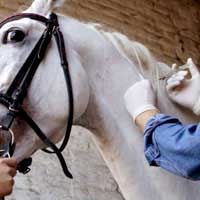
Our MRSA risks are likely not as high as vets, simply because we don't usually find ourselves around a lot of sick horses. But here are a few precautions for horses and humans: are a good idea:
- Wash your hands with soap and water when handling an animal with an infected wound, boil, or sore.
- Studies show that alcohol-based hand sanitizers are very effective, but they're most effective when applied to relatively clean hands.
- Be alert to MRSA like symptoms -- pneumonia, skin or soft tissue infection (especially the limbs), catheter site infections, etc. If a problem seems unusually persistent or severe, call the vet. If you note it in someone else's horse, encourage the barn manager or the owner to call a vet (yes, be a buttinsky!).
- Bandage wounds and avoid contact with animal/people wounds
- Don't share horse or human personal items (clippers, hoof picks, etc)
Twenty percent of horses diagnosed with MRSA infections die, and I don't know the mortality rate for humans. A good reason to be vigilant!
RESOURCES
Good Hygiene blocks horse-human MRSA transmission in The Horse magazine
MRSA is a growing problem in horses from New Zealand Horse Talk
MRSA and horses: What you need to know from U of Florida Veterinary School
MRSA strains in horses from MRSA blog
MRSA infections in horses from Equidblog
MRSA and horses from the University of Liverpool
Tuesday, February 17, 2009
Equestrian acrobatics for the rest of us
 Things I doubt I can do...
- I can't mount a horse bareback (I can mount w/o a mounting block, but then I'm tall).
- I doubt I can do a flying dismount--you know, where you swing your legs over the rump, click your heels, and exit stage left? I won't even try it.
- I can't post the trot w/o stirrups . Take some jello cubes, put them in a sandwich bag, shake gently, and squint at it a bit, you'll almost be able to see my likeness at posting trot, no stirrups.
I saw an interview with the jockey. He was highly motivated to hang on -- when he started to fall he saw the thundering herd behind him and thought it would be safer just to dangle. And besides, I think he got some prize money!
Monday, February 16, 2009
Looking for the perfect Frieisan?

Inspections and judging
The KFPS sponsors inspections of breeding stock. At inspections, foals are assigned a premium status (1-3) or no status. Apparently any white on the animal is the kiss of death from the breeding standpoint. The KFPS has quality designations (my term) or predicates (their term), similar to what other registries have (e.g., an elite or SPS mare for hanoverians). Predicates are sometimes awarded at inspections or shows. Here is a short summary of what they mean, paraphrased from the FHANA web page Predicates Explained.
Star/ster predicate: Awarded at inspections to mares/geldings having particularly high quality movement and conformation.
Crown predicate: To be awarded this predicate, a mare must be a) designated as first premium, b) she is selected for this designation at the Central Mare Show/Centrale Keuring (or a similar show in other countries), and c) achieves an acceptable score at a performance test.
Model predicate: "The very best of the star mares are model mares," according to the KFPS. The mare must be star mares age 7 or older, fertile (has had a baby), stand at least 15.2 1/4", and meet strict standards for the breed. The Model predicate is provisional until the mare passes a performance test. Preferent predicate: This is designated based on quality of offspring; the mare must have produced at least four quality offspring which were a star or model mare or gelding; a studbook stallion with breeding privileges, or a stallion that reached the second level of a recognized stallion judging.
Performance Mother (Prestatie) Register -- This is granted when the mare in question has produced at least four quality horses--either Ster or Model mares or Ster Geldings, Foal Book Ster stallions, studbook stalions, or stallions that made the second viewing of an inspection.
Performance-dam/Prestatiemoeder Predicate: The is awarded to mares that have produced three direct offspring that were awarded the Sport predicate.
Preferent for Stallions: The Preferent predicate can be awarded to stallions that have a lasting, special influence on the breed.
Performance-dam/Prestatiemoeder Predicate: The predicate Performance dam/Prestatiemoeder is awarded to mares that have produced three direct offspring that were awarded the Sport predicate.
RESOURCES
Buying a Friesian Horse from the Friesian Horse Association of Great Britain and Ireland
Choosing a friesian decision tree from Proud Meadows Farm
Sunday, February 15, 2009
Red Kitka's views on Monday
At the end of the day, I know when Bob is almost home because Red Kitka gallops through the house and into the living room, where he leaps to the front window to watch for Bob's approach. You'd think Elvis himself is about to stroll through our front door. Red Kitka is living proof that animals miss us and think about us when we're gone.

I snapped this picture tonight (Sunday night). On Sunday nights, Red Kitty seems pretty bummed out. I think he knows Bob will be gone tomorrow, and misses him already.
So I hold the red kitty and sing to him (talk about insult to injury):
So I hold the red kitty and sing to him (talk about insult to injury):
Monday Monday, can't trust that day,
Monday Monday, it means my daddy goes away
Oh Monday morning's alarm clock is warning of what is to be
Oh daddy daddy, how could you leave and not take me?
Saturday, February 14, 2009
Update on weighted surcingle
 Jackie and Ace from Regarding Horses
 One trainer's view
The farm manager/trainer said that the trainer who purchased the weighted surcingle is no longer there, and they no longer use it at the farm. His opinion was "I would not recommend it to anyone," and he described it as 'faddish.'
The standard grain of salt...
There was a slight mixed message, however. The trainer did not want to sell or rent me the surcingle, saying he might need it at some point. He also could not/would not provide detail on why he held a dim view of the surcingle. He did not say that the product does not do what it claims to do. I was curious about why it was not used, and pressed him a bit for details. Was the surcingle was just too much trouble? Were there issues with fit? Did horses react badly? My questions went unanswered. I appreciated the trainer's time, and he clearly wanted to help me. But was his assessment 100% fair and accurate? I'm not sure. Knowledgable, experienced trainers often have their own preferred methods and strong opinions about what works. I wish he could have backed up his opinion with some examples.
My decision...
My thoughts after this? Well, the conversation gave me pause, and then I went online to review the product info. I had never been to the order page and wanted to see if shipping was included (for an item this heavy it could be significant). I noticed that a) the price increased to $425 and b) shipping of this hefty item is now included in the purchase price.
So you won't be too surprised to know that there is no Astride in my future. I'll be doing it the old fashioned way. This isn't a thumbs down review, however. After reading what I've read about it, I feel that it could be very useful at large farms with a lot of youngsters. If I backed more than 1-2 horses a year I might make a different decision. It's just not a good fit with my situation..
Friday, February 13, 2009
Valentine's Day musings, and a thank you....

There, I feel better now. Anyway....
This is a valentine is for the BTB readers and fellow bloggers I've had the chance to talk to (via email, chat, Facebook, etc.) Whether it's Barbara Martin's thoughtful blog comments, Oh Horsefeathers topical and authoritative blog, A Bay Horse's engaging style, or the oh so relevant and well-spoken Grey Horse Matters, I can truly say that reading and interacting with everyone has been a real source of joy.
And now, scroll down for some valentine images...


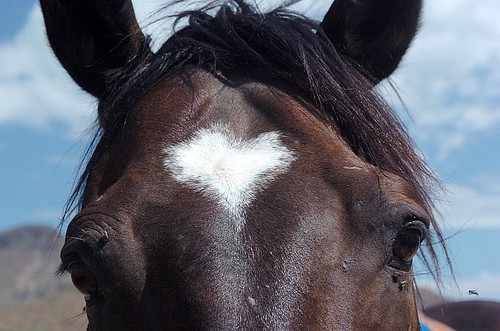
 From Blogcadre.com
 From http://www.ragamufyn.blogspot.com/
Thursday, February 12, 2009
Two invitations in one article!
INVITATION TO DINE
Hey, who is going to Rolex this year? A BTB reader suggested we try to get together one night for dinner. Time, date, location are TBD. But RSVP in Comments.
INVITATION TO SHARE One of the challenges of blogging is finding visuals/images for each article. Some readers have sent me pix of their horses, which I really enjoy, and I have connected with readers on Facebook who have let me use one of their Facebook photos in a blog article.
So, I thought I'd invite readers to send me any pix of their horses that they wouldn't mind sharing on the blog. They can be "at home" shots, competition shots, or farm/barn/pastures shots.
I'll include any information about you or your horse, and if you have a blog or horse-related business, I'll include that too as either a caption or info that you see when you hover over the image. You can send any photos and posting requests (desired captions, etc.) to sek4278 @ gmail.com but here are the disclaimers:
- I can't guarantee if or when I'll use your photo (would like it to fit the article)
- No compensation is available for using photos, although I'll credit your work in any way I can
Stacey
Wednesday, February 11, 2009
Natal Clasi: Brindle stallion's babies
Last spring I wrote an article about Natal Classi, the brindle warmblood imported from Brazil several years ago. I had a few long and enjoyable conversations with Doni Biggs, his owner, hoping to write an article based on the interview. I never completed the article, but recently Natal is back in the news -- has has two foals on the ground! Here's a recent picture from Stoney Brooke farm where he is currently standing in Kentucky.
 clipped from http://www.stoneybrookefarm.com/horses/Natal/
Natal Classi

 |
Brindle gossip Central
You can read this post on COTH to get the latest buzz on Natal. The Stoney Brooke Farm owner leads a discussion of Natal in this recent thread on groomingsupplies.com. The "buzz" is alternately fawning and skeptical. There's some conjecture about why Natal has not been campaigned, marketed, or bred extensively. From my talks with Doni, I think the answer is just that Doni is a pretty independent spirit, and after a lifetime in horse breeding she's not that interested in playing by the rules. Also she has some health concerns. But I admit I don't really know why we haven't seen more of Natal. Me, I'd be booking him on the Horse Expo circuits and giving the public a big treat!
And now, the baby!
He has had two babies, one with some brindle patterning at birth. Here are a few pictues of the patterned foal...


Apparently he's lost the patterning, but there is a chance it will return. At any rate, here is an inspection photo. Is he not lovely?


Tuesday, February 10, 2009
Teddy O'Connor's full sister: Sneak peek
Doggone it! This was supposed to be Tuesday night's entry! For those of you who caught my accidental posting, sorry I retracted it for a bit. Oh well. She looks HEALTHY doesn't she? Chubbiest event pony I've ever seen! Breeding is such a crap shoot -- hope she follows Teddy's footsteps.
Monday, February 9, 2009
When a horse dies: Considering cremation
 In an Washington Post article about Barbaro, Jane Smiley wrote " there is something extra large about the death of a horse." It's more than just their size, although I suppose that's part of it. Smiley is saying that horses are an enormous presence in our lives. But when they die, it is their physical size that brings us face to face with sad practicalities. As a peripheral observer when a horses have died at boarding barns, I know that whatever happens, happens fast. If anything there is a tarp on the ground for awhile, and then the horse is just gone.
I'm not overly sentimental, but who doesn't want dignified treatment of a deceased equine friend? If I can afford the horse, can't I afford to see that my horses aren't simply discarded? There are bereavement/cemetery services that try to meet the needs of horse owners. Some offer burials, but cremation of horses is a growing trend as land becomes more scarce and burial restrictions impinge on once-rural areas. The question is whether cremation is a feasible choice for me. Here is what I learned from a bit of research.
Cremation: An overview
Cremation fees include "respectful" removal of the horse , the actual cremation, and the urn to hold the ashes.
Transport
Companies say that the transport vehicle is customized with features that facilitate respectful handling of the animal. I wonder if they aren't similar to the emergency vehicles they use at vet facilities. Some vehicles are refrigerated, but I don't find that especially comforting. Transport of the animal can be as high as $3-5/mile, and many services do not permit "drop-offs."
Horse Cremation
I checked a number of web sites -- very non-scientific! For a pony or Foal, fees ranged from $600-$1000. For a horse (1000-1600lbs.), the range was $1000-$1998. Some companies allow you to be present at the cremation; this is usually done to ensure the right remains are returned. I'm not sure how "up close" you'd get, but if you're considering this you might want to take a look at two large animal cremation units I found on the Web (one and two). Some services offer communal cremations (more than one animal) -- these are less expensive. Remains
You may choose to have your horse returned in a plastic container, ready for ceremonial spreading, or a wooden urn which usually involves an extra charge ranging from $100 to $300. One company makes a tiny necklace that holds a small sample of the horse's ashes.
No frills cremation/disposal
You can also find more basic cremation services from animal diagnostic labs -- labs may offer disposal and/or cremation, often at a reduced cost. Keep in mind that this is a no frills option, and you may or may not get a bedside manner at these rates. For example, the Illinois lab Web site states that "cremation with ashes returned is $.15 per/lb." There may also be restrictions on how or whether they accept an animal. You will find a listing of vet schools and labs at Vets for Equine Welfare.
I've made a few calls -- there are companies that offer cremation in my area -- but haven't decided what I'll do. Knowing me, probably whatever is simplest and fastest.
RESOURCES
Paws to Heaven
Eden Memorial Pet Care
To cremate or not? from Apples and Oats
Horse funerals
Cremate dead horses? Why not some say from the NYT
Ask the experts: Cremation
Sunday, February 8, 2009
Ice woes and a a throbbing foot
She was out within 20 minutes. Thank goodness, Jake is fine. He's a spry little guy, I didn't know he was 27 years old. Poor boy! We figure he'll be sore for a few days. He has a bump on his rear cannon bone but aside from that he is well, all bandaged and banamined up. Ironically his owner could not come out to check on him because she had fallen on the ice the previous day.
Did I mention I HATE THIS ICE????
To top off the day, Riley stepped on my foot while I was changing his blanket. He had a "duh" look as I screamed "Get off me!" at volume 10. Guess Jake and I will both be a little sore.
Friday, February 6, 2009
Animal Planet's Jockeys: A Review
 Well, I made a point of being home last night to see the show Jockeys. The previews were enticing, very stylized and edgy. I felt that a tuned in, horse-loving hipster such as myself should watch it. I wanted both education and entertainment, which is setting the bar pretty high for contemporary TV.
The first show
Last night's premier was an hour long, two segments back to back. There was the standard introduction to the jockeys and their personal stories. But the theme of the first episode is danger. We see a few bad falls and watch jockeys pray and see horses rear in the starting gate. Two featured jockeys are injured -- one squishes her foot, another breaks a collar bone. Next week's theme is a bit lighter (so to speak): weight management.
Educational?
Did I learn something about racing? Yes. I learned that the second most dangerous job at the racetrack is working at the starting gate (which I correctly guessed), and I learned that Santa Anita has 2,000 horses in sixty barns. I learned about the hardships of the racing jockeys, lots of risk for low low pay unless you're at the top. But the show was not really about educating viewers.
Entertaining?
Was it entertaining? Yes. But I'd hardly call it groundbreaking. The script didn't vary much he standard reality show formula. Young turk versus established older pro. Woman loves man, unrequited love. Unknown struggling at the bottom. It's a lot classier than Housewives of Orange County, but certain scenes are a little campy. For a first show, setting the stage, I'd give it a B or B-, but showing potential. What I didn't like...
Annoying music
I liked the music in the previews, so it was disappointing to find that the use of music was at times annoying. When the plot suggests something sad/poignant, I don't need to be hit over the head with a overbearing soulful background vocals to make absolutely sure I get the point.
Annoying woman
A Canadian jockey moves to California to be near her jockey boyfriend. She moves into his condo. We watch her casually overtake the bedroom with her clothing and other belongings while the boyfriend watches sulkily. Did she not see How to lose a guy in 10 days? She has a vapid kind of "Hollywood pretty," she doesn't really have that jockey toughness or confidence, and we don't see her ride. At this point she's just a clingy girlfriend.
Annoying whiteness
Okay, there are jockeys named Mike and and Corey and Joe and Aaron and Kayla and Chantal. I see no Miguels or Jorge's or Angels or Jesus'es, even though it seems a huge percentage of jockeys are non-caucasion. Doesn't that seem odd? Can anyone explain this? Will we meet some new faces next week? I hope so.
Annoying horses-as-backdrop
I should have anticipated that a show named Jockeys will not necessarily devote a lot of time to the horses. But I was hoping. Maybe I should suggest another show, Thoroughbreds.
Annoying grammar
Quote from Joe the jockey:
"It doesn't get any more better than this."
I'm a rather critical sort, but despite these downer observations I'll be watching next week. What did y'all think?
My favorite freestyle ever
Thought I'd share what may be my favorite freestyle-- well, either my favorite or tied with Anky and Bonfire's West Side Story freestyle. This was the best footage I could find (sorry about the sound quality). The indoor video of the same freestyle looks very subdued. If I could pick someone to model my own riding after, it would be Ulla Salzgeber. Her relaxation and control amaze me.
Hope I get the chance to see her ride someday. She occasionally coaches Chris Hickey at Hilltop Farm, so there is hope! You can read about a clinic that she offered in Texas in this Equisearch article.
Taking the night off from blogging. I'm hoping to watch Jockeys tonight and do a little writeup.
Thursday, February 5, 2009
He ain't heavy, he's my training aid
 I'd like to ask your opinion on something. Here's the deal. An Illinois company called Eponaire makes a product called Astride (pictured left). It's basically a surcingle with removable weights. The idea is that you start with a few weights, and as the horse develops muscling along his back and abdomen you add more. Over time the horse is conditioned to physically support the weight of a human rider. Scott Hassler used to promote it for Hilltop Farm, and now Robert Dover is the spokesman.
Product details
The wool-flocked surcingle weighs six pounds by itself, and a series of pockets hold up to 13 weight bags (total 110 lbs). The bags are filled with small lead balls that shift like sand. The weights are distributed on the surcingle to simulate a rider aboard the horse. The design protects the spine encourages the horse to lift his back, while ample padding adds stability and eliminates pressure points. (excerpted from Making Strides from Blood Horse).
Oh, no, another gadget!
If you read this blog regularly, you know I'm a sucker for gadgets. But this idea does have a basis in research. It originated with Dr. Hilary Clayton, McPhail Dressage Chair in Equine Sports Medicine at Michigan State University. She used a prototype of this product in two studies. In the studies, horses between 18-30 months old were exercised in a “weighted vest that’s like a saddle pad with pockets for weight." Adding supplemental weight during exercise stimulated bone and muscle development in young horses (from Let the Training Begin! from Blood Horse).
On the psychological side...
Astride also makes sense from the standpoint of animal psychology. A principle of behavioral psychology called shaping posits that ya don't ask for the whole enchilada at once. If you're teaching a horse to bow, you first reward any step in the right direction, like downward movement of the head. Ask for a little more each time, and eventually the horse is kneeling down with his nose touching the ground on cue. Similarly, if you want a horse to accept 130 lbs on their back without a big fuss, you might want to start with 20 lbs. It seems kinder and gentler to the horse, not to mention the rider. If the horse is happy, the rider is less likely to get dumped.
So what do you think?
I really like the idea. But at a price of between 300ish dollars, I'm not sure I can justify the expense for my one young horse. I've thought about reselling it when I'm done, but when I posted queries to horse bulletin boards, not one respondent had actually used it. So I'm not sure about its resale potential. Decisions, decisions.
Tell me what you think!
RESOURCES
Let the training begin from Blood Horse
Making Strides from the Blood Horse
Wednesday, February 4, 2009
"Is your horse for sale?"
 You're at a show, and you have a great day with your horse -- the trailer is lined with ribbons, mostly blue. You're relaxing in your folding chair, and notice someone standing in front of you. "My daughter is looking for a high end [dressage/jumping/hunter] and she loves the horse you brought today. Is he for sale?"
There are two options, really.
- If the horse is Harvey (or your horse of a lifetime), selling is out of the question. You say: "Sorry. He just isn't the kind of horse you sell. But thank you."
- If, anywhere in the recesses of your brain, you imagine for a moment that you might part with your horse if it was a good home, force yourself to answer something like this: Well, everything's for sale." Shrug, smile.
"But I love my horse!"
Yep, I hear ya. I love Riley a lot, and my heart melts a little every time I see him. But he doesn't hold the same place in my heart that Harv does -- at least not yet. A tiny part of me can envision selling him, IF...
- I discover that Riley doesn't like dressage but is suited to jumping or
- IF a buyer offers me more than he is realistically worth.
Danny the show jumper
An acquaintance of mine bought an appendix quarter horse as a 3 year old. She trained him herself and eventually competed him in 3'6"/3'9"' jumpers. They cleaned up at every show one season. After one particularly good day, my friend got a 50K offer, no vet check. It was more than the horse was worth, in her opinion. But she liked him and was having fun. She said 'no.' A year later, the horse was diagnosed with navicular changes and was retired. She is still kicking herself. She'll tell anyone who will listen not to turn down a good offer. "I could've bought a horse with straight legs!" she laments.
 Dijou the dressage horse
 I contacted the owner of a 1/2 sister to Riley, a mare that shared the same mom as Riley. The mare was competing at Prix St. Georges as a 7 year old, and I wanted to get the scoop from the owner. In a phone call, she told me she had sold the mare. She loved the mare, but they offered "an outrageous sum of money." She told me many stories of how special the mare was -- she could ride her bareback with a halter, she was child safe under saddle, etc. I marveled that this woman could part with that horse she so clearly loved. Her answer was, "She has a great home and she's doing great. I needed her more than she needed me! There is always another horse."
Elise the broodmare
On a horse breeder's forum, a breeder asked other breeders if she should sell her best mare (she had received a good offer). Almost EVERY breeder said SELL, because you can bargain to retain breeding rights, and there are many great broodmares out there. The money is an opportunity to improve your stock. In the end, they advise the breeder to sell her risky venture and opt for money in the bank.
A parting thought...
In Europe, there is a saying that when you go to see your horse, you can't be certain whether you'll find him "toes up or toes down." If you think of horses as primarily a financial investment, or if you feel your horse can lead a happy life under someone else's care, this makes good sense. It's harder when you love your horse like a child, as so many of us do. I suspect most of us would try to do what is best for our horse -- just like good moms!
Subscribe to:
Comments (Atom)


.jpg)


